Solved past papers for the assistant in the Energy Department and the Women’s Development Department in 2021
The Balochistan Public Service Commission advertised the post of Assistant in the Energy Department and Women Development Department, Quetta, Balochistan. The written evaluation test for selection to the post of assistant in the said department was held on September 16, 2021, through BPSC. Here are the past papers of the assistant in the Energy Department that we have solved and shared with you to prepare the students for upcoming exams.
This past paper for the assistant in the Energy Department and Women Development Department is in two parts: an essay (English and Urdu) and Pakistan affairs.
👇 Below is the solution to all the questions of Part 2 with explanations. Best-solved paper for you.
assistant in the Energy Department
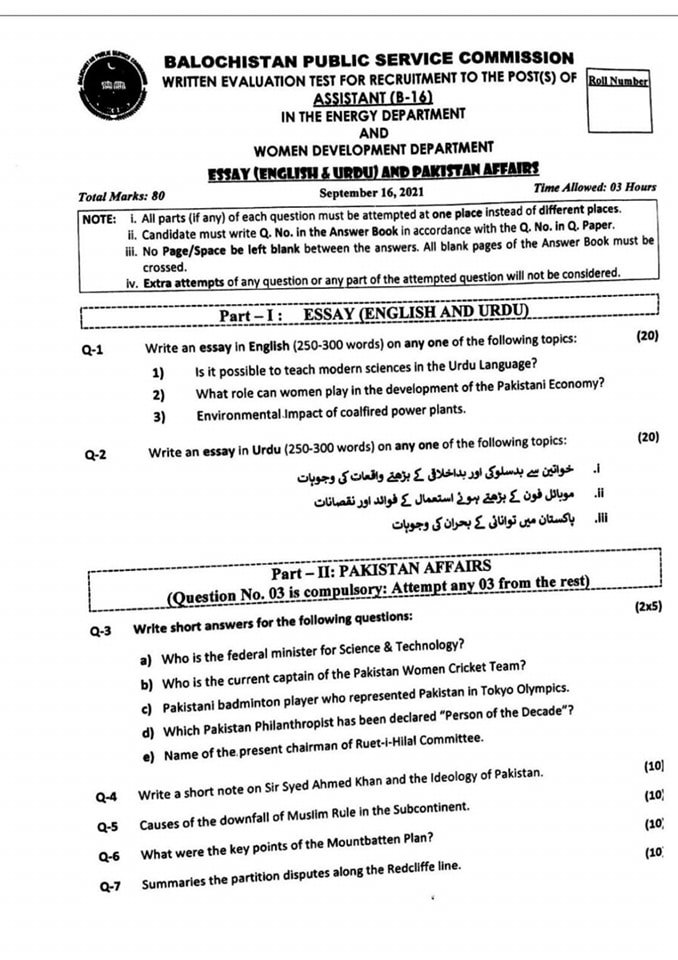
Assistant in the Energy Department
Q3: Write short answers
c) Pakistani badminton player at the Tokyo Olympics:
Mahoor Shahzad represented Pakistan, becoming the first-ever Pakistani badminton player to qualify for the Olympics (Tokyo 2020/2021).
d) Pakistani philanthropist declared “Person of the Decade”:
Bilquis Edhi was declared the “Person of the Decade” (Bidecadal 2000–2020) by Impact Hallmarks in January 2021.
Awarding body: The title “Most Impactful Person of the Bidecadal 2000–2020” was conferred by the international organization Impact Hallmarks (IH) in January 2021.
Shared honor: She received this recognition alongside UN human rights rapporteur Professor Yanghee Lee and American ethicist Stephen Soldz, selected from prominent figures across 190 countries.
Her work: Known as the “Mother of Pakistan,” she ran the Bilquis Edhi Foundation for over six decades and is credited with saving more than 42,000 abandoned babies through the “jhoola” (cradle) initiative at Edhi centers.
Other honors: She had previously received the Hilal-e-Imtiaz, the Lenin Peace Prize, the Mother Teresa Memorial International Award for Social Justice (2015), and the Ramon Magsaysay Award for Public Service.
Continuing legacy: After her husband Abdul Sattar Edhi’s death in 2016, she led the Edhi Foundation’s welfare work alongside her son Faisal Edhi until her own passing in April 2022.
e) Present Chairman of the Ruet-e-Hilal Committee:
Maulana Syed Muhammad Abdul Khabir Azad was the Chairman of the Central Ruet-e-Hilal Committee at the time of this exam (appointed on 30 December 2020, succeeding Mufti Muneeb-ur-Rehman).
Important Past Paper Links
Here are the important past paper links for you to prepare yourself for any type of exam in the future.
- FIA (ASI) Solved Past Paper
- All Post-Past Papers
- Planning Officer Past Paper
- Assistant (B-16) Solved Past Paper
Part 2: Pakistan Affairs
Q4: Write a short note on Sir Syed Ahmed Khan and the ideology of Pakistan.
Sir Syed Ahmed Khan (1817–1898) was a visionary reformer who believed Muslims of India needed modern education to progress alongside Hindus and the British. He founded the Muhammadan Anglo-Oriental College at Aligarh in 1875, which later became Aligarh Muslim University, blending Western science with Islamic values. He propounded the Two-Nation Theory, arguing that Hindus and Muslims were distinct nations with separate religions, customs, and social systems, unable to progress together under one democracy. His ideas laid the ideological foundation that was later carried forward.
Q5: Causes of the downfall of Muslim rule in the subcontinent.
The decline of Muslim rule began with weak successors after Aurangzeb, who lacked the administrative and military ability to hold the vast Mughal Empire together. Constant wars of succession, court intrigues, and moral decline among the nobility weakened central authority. Regional governors like those of Bengal, Awadh, and Hyderabad became independent, fragmenting the empire into smaller states. Economic decline, heavy taxation, and neglect of agriculture caused widespread poverty and unrest among the masses. Meanwhile, the British East India Company exploited this disunity through superior strategy, diplomacy, and military technology, gradually annexing Muslim territories until complete political control was lost.
مسلم اقتدار کا زوال اورنگ زیب کے بعد آنے والے کمزور جانشینوں کے دور سے شروع ہوا، جن میں وسیع و عریض مغل سلطنت کو متحد رکھنے کی انتظامی اور عسکری صلاحیت کا فقدان تھا۔ جانشینی کی مسلسل جنگوں، درباری سازشوں اور امرا میں اخلاقی گراوٹ نے مرکزی اختیار کو کمزور کر دیا۔ بنگال، اودھ اور حیدرآباد جیسے علاقوں کے گورنر خودمختار ہو گئے، جس کے نتیجے میں سلطنت چھوٹے چھوٹے حصوں میں بٹ گئی۔ معاشی زوال، بھاری ٹیکسوں اور زراعت سے غفلت نے عوام میں بڑے پیمانے پر غربت اور بے چینی کو جنم دیا۔ اسی دوران، برطانوی ایسٹ انڈیا کمپنی نے اپنی بہتر حکمتِ عملی، سفارت کاری اور عسکری ٹیکنالوجی کے ذریعے اس انتشار کا فائدہ اٹھایا اور بتدریج مسلم علاقوں پر قبضہ کرتے ہوئے بالآخر مکمل سیاسی اختیار بھی ختم کر دیا۔
Q6: What were the key points of the Mountbatten Plan?
- Announced on 3 June 1947 by Lord Mountbatten, it proposed the partition of British India into two independent dominions: India and Pakistan.
- The provinces of Punjab and Bengal were to be divided based on Muslim and non-Muslim majority areas, decided by their respective legislative assemblies.
- A referendum was to be held in the North-West Frontier Province and Sylhet district of Assam to decide accession.
- Princely states were given the choice to join either India or Pakistan, or in special cases, remain independent.
- Power was to be transferred by 15 August 1947, and a Boundary Commission was set up to demarcate final borders.
Q7: Summarize the partition disputes along the Radcliffe Line.
- The Radcliffe Line, drawn by Sir Cyril Radcliffe, divided Punjab and Bengal between India and Pakistan in a rushed five-week period with little local knowledge.
- The boundary award was kept secret until after independence, causing confusion and panic among millions of people on both sides.
- Major disputes arose over Gurdaspur district, awarded to India, which gave it land access to Kashmir and fueled later conflict.
- Canal headworks, irrigation systems, and railway lines were split arbitrarily, disrupting agriculture and transport in both Punjab and Bengal.
- The unclear and hurried division triggered mass migration and communal violence, resulting in one of history’s largest and bloodiest population transfers.