Best Solved Past Paper of the Assistant Anti-Corruption Department Establishment, Balochistan, October 27, 2020
The Balochistan Public Service Commission (BPSC) announced the post of Assistant Anti-Corruption Department, Establishment, Quetta, Balochistan, through an advertisement, and the test was conducted on 27 October 2020. Here we solved all the questions of the paper. I hope it will help you a lot in your future exams.
This subjectively based past paper of the Assistant Anti-Corruption Department in the ANTI-CORRUPTION ESTABLISHMENT Department, Balochistan, is in two parts:
- an essay
- Pakistan affairs.
👇 Below is the solution to all the questions of Part 2 with explanations. Best-solved paper for you.
Assistant Anti-Corruption Department
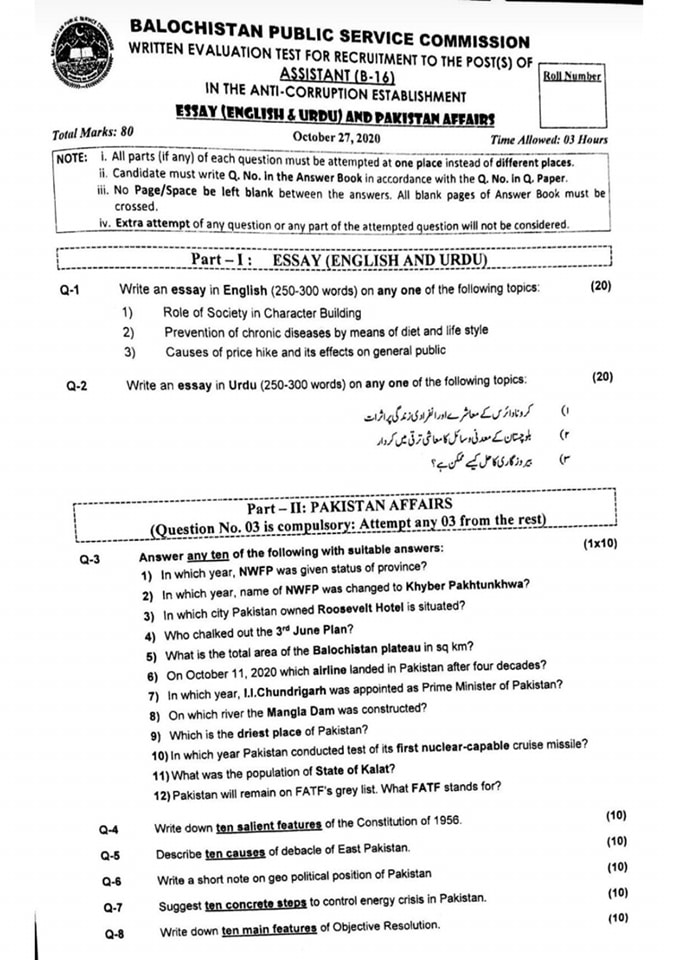
Part 2: Pakistan Affairs
Past Paper Assistant Anti-Corruption Department
Q4. Write down ten salient features of the Constitution of 1956.
- Islamic Republic—Pakistan was declared an Islamic Republic for the first time in its constitutional history.
- In the federal system, powers were divided between the center and the two provinces.
- Parity—East and West Pakistan were given equal seats in the National Assembly.
- One Unit—all West Pakistan provinces were merged into a single unit.
- Parliamentary government—a unicameral legislature with the prime minister as the real executive head.
- President as head of state—must be a Muslim, elected indirectly.
- Fundamental rights—guaranteed and justiciable rights for citizens.
- National languages—Urdu and Bengali—were recognized as state languages.
- Independent judiciary—with the Supreme Court as guardian of the constitution.
- Directive Principles—non-binding guidelines for state policy on welfare and Islamic values.
Important Past Paper Links
Here are the important past paper links for you to prepare yourself for any type of exam in the future.
- FIA (ASI) Solved Past Paper
- All Post-Past Papers
- Planning Officer Past Paper
- Assistant (B-16) Solved Past Paper
Q7. Suggest ten concrete steps to control the energy crisis in Pakistan.
- Expand hydropower—fast-track dams like Diamer-Bhasha to add cheap, clean capacity.
- Invest in renewables—scale up solar and wind projects, especially in Balochistan and Sindh.
- Reduce line losses—upgrade transmission networks to cut technical and theft losses.
- Curb circular debt—improve billing, recovery, and subsidy targeting across the power chain.
- Diversify fuel mix—shift from costly imported fuel oil toward indigenous coal and gas.
- Promote energy conservation—enforce efficiency standards for appliances and buildings.
- Develop Thar coal—accelerate local coal-based power generation to cut import bills.
- Encourage nuclear power—expand safe nuclear plants for stable baseload supply.
- Attract private investment—offer incentives for IPPs and public-private energy projects.
- Modernize grid infrastructure—install smart meters and upgrade aging distribution systems.
Q5. Describe ten causes of the debacle of East Pakistan.
- Language controversy—imposing Urdu alone angered Bengali speakers, sparking the 1952 language movement.
- Political deprivation—Awami League’s 1970 election win was denied a power transfer.
- Economic disparity—East Pakistan received a far smaller share of development funds.
- Six Points movement—Mujib’s autonomy demands were rejected, deepening distrust.
- Under-representation—Bengalis were sidelined in the civil service and the armed forces.
- One unit and parity—denied East Pakistan’s rightful majority based on population.
- Delay in power transfer—talks between Bhutto, Yahya, and Mujib collapsed in early 1971.
- Operation Searchlight—the March 1971 military crackdown—triggered civil war.
- Indian intervention—India armed and trained Mukti Bahini, then invaded directly.
- Weak governance—poor administration and neglect—widened the trust gap with the center.
Q8. Write down ten main features of the Objective Resolution.
- Sovereignty belongs to Allah—exercised by the state through its people as a sacred trust.
- Authority delegated—the state to exercise power through chosen representatives.
- Islamic principles—democracy, freedom, equality, tolerance, and social justice as laid down by Islam.
- Islamic way of life—Muslims to order their lives per the Quran and Sunnah.
- Minority rights—minorities are free to profess their religion and develop their culture.
- Federation—Pakistan’s territories to form a federation with autonomous units.
- Fundamental rights—equality of status, opportunity, and justice—are guaranteed to all citizens.
- Freedoms guaranteed—thought, expression, belief, faith, worship, and association.
- Independent judiciary—to safeguard rights and uphold the constitution.
- Territorial integrity—sovereignty and integrity of Pakistan’s territories protected.
BPSC Assistant Anti-Corruption Department
1) In which year was NWFP given the status of a province?
Answer: 1901
The North-West Frontier Province (NWFP) was formed out of Punjab and established as a separate administrative province by the British in 1901 under Lord Curzon. It remained a distinct province until independence and after, until its name was later changed. This was primarily done for better administrative and military control of the frontier region.
2) In which year was the name of NWFP changed to Khyber Pakhtunkhwa?
Answer: 2010
The name was officially changed from North-West Frontier Province (NWFP) to Khyber Pakhtunkhwa (KP) through the 18th Constitutional Amendment, passed in April 2010. The renaming reflected the ethnic and cultural identity of the Pashtun-majority population. It ended a long-standing demand of nationalist parties in the province.
3) In which city is the Pakistan-owned Roosevelt Hotel situated?
Answer: New York City, USA
The Roosevelt Hotel is a historic hotel located in Manhattan, New York City. It has been owned by Pakistan International Airlines (PIA) since 2000, through its subsidiary. The hotel was later closed and used to shelter migrants before its ownership dispute got attention again in recent years.
4) Who chalked out the 3rd June Plan?
Answer: Lord Mountbatten
The 3rd June Plan (also called the Mountbatten Plan) of 1947 was drafted by Lord Louis Mountbatten, the last Viceroy of India. It laid out the framework for the partition of British India into two independent states, Pakistan and India. It was accepted by the Muslim League and the Congress, leading to independence on 14–15 August 1947.
5) What is the total area of the Balochistan plateau in sq km?
Answer: Approximately 347,190 sq km
Balochistan is Pakistan’s largest province by area, covering roughly 347,190 square kilometers, which is about 44% of the country’s total land area. Its terrain consists mainly of a high, arid plateau surrounded by mountain ranges. Despite its huge size, it is the least densely populated province.
6) On October 11, 2020, which airline landed in Pakistan after four decades?
Answer: British Airways
British Airways flight BA-259 landed at Allama Iqbal International Airport, Lahore, on 11 October 2020, resuming direct operations after nearly 40 years. British Airways had earlier restored its Islamabad route in 2019 after a decade-long suspension following the 2008 Marriott Hotel bombing. The Lahore route marked a further step in rebuilding UK–Pakistan air connectivity.
7) In which year was I.I. Chundrigar appointed as Prime Minister of Pakistan?
Answer: 1957
Ismail Ibrahim Chundrigar served as the 7th Prime Minister of Pakistan in 1957. His tenure was one of the shortest in Pakistan’s history, lasting only about two months (October–December 1957). He led a coalition government during a politically unstable period marked by frequent changes of premiership.
8) On which river was the Mangla Dam constructed?
Answer: River Jhelum
Mangla Dam is built on the River Jhelum in Azad Jammu and Kashmir. It is one of the largest dams in the world and a key part of the Indus Basin water system. Completed in 1967, it primarily serves irrigation and hydroelectric power generation purposes.
9) Which is the driest place in Pakistan?
Answer: Nokkundi, Balochistan
Nokkundi, located in the Chagai district of Balochistan, is recorded as the driest place in Pakistan due to its extremely low average annual rainfall. The region lies in a desert zone with harsh, arid climatic conditions. Panjgur is also sometimes cited among Balochistan’s driest areas.
10) In which year did Pakistan conduct the test of its first nuclear-capable cruise missile?
Answer: 2005
Pakistan successfully test-fired its first indigenously developed nuclear-capable cruise missile, Hatf-VII “Babur,” in August 2005. It has a range of around 700 km and can be launched from land, sea, or air platforms. This test marked a significant milestone in Pakistan’s strategic missile development program.
11) Pakistan will remain on FATF’s grey list. What does FATF stand for?
Answer: Financial Action Task Force
FATF stands for the Financial Action Task Force, an intergovernmental body established in 1989 to combat money laundering and terrorist financing. Countries placed on its “grey list” are subject to increased monitoring for deficiencies in their financial compliance systems. Pakistan remained on this list for several years before being removed in October 2022.