Best solved all MCQs from the past paper of the Assistant Director Sports in the Sports and Youth Affairs Department, Balochistan
The Assistant Director Sports at the Department of Sports and Youth Affairs, Balochistan, was announced a job post through a local newspaper advertisement, and the test was conducted by BPSC on May 27, 2025, through the Balochistan Public Service Commission. Here are the complete solved MCQs of the above past paper of the Assistant Director Sports Officer job post test; you can read and prepare for future exams
👇 Below are the complete solved MCQs with explanations from the Assistant Director Sports Past Paper that you can read and prepare yourself.
Assistant Director Sports
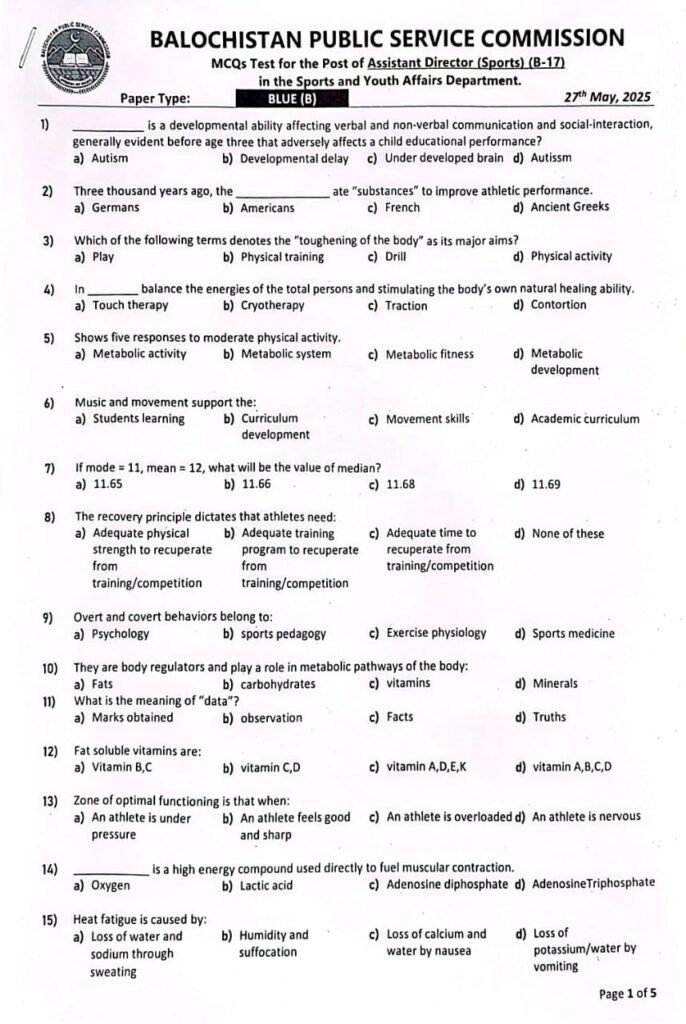
BPSC ASSISTANT DIRECTOR SPORTS—PAST PAPER SOLVED MCQs
1) ______ is a developmental ability affecting verbal and non-verbal communication and social interaction, generally evident before age three, that adversely affects a child’s educational performance?
- a) Autism ✅
- b) Developmental delay
- c) Underdeveloped brain
- d) Autism
Answer: a) Autism
Autism is a neurodevelopmental condition that impairs verbal and non-verbal communication as well as social interaction. Symptoms are usually noticeable before the age of three. It also affects a child’s educational performance due to communication challenges.
2) Three thousand years ago, the ______ ate “substances” to improve athletic performance.
- a) Germans
- b) Americans
- c) French
- d) Ancient Greeks ✅
Answer: d) Ancient Greeks
Historical records show ancient Greek athletes consumed special foods and substances, such as figs and herbal preparations, believing they enhanced strength and performance. This is considered one of the earliest recorded forms of doping in sports history.
3) Which of the following terms denotes the “toughening of the body” as its major aim?
- a) Play
- b) Physical training ✅
- c) Drill
- d) Physical activity
Answer: b) Physical training
The term “physical training” (PT) denotes a systematic regimen of exercises explicitly aimed at the “toughening of the body,” developing physical endurance, conditioning muscles, and building overall physical resilience
- Play → Mainly recreational and developmental.
- Physical training → Systematic conditioning and toughening of the body. ✅
- Drill → Repetitive practice, often for discipline and coordination.
- Physical activity → General bodily movement.
4) In ______ balance the energies of the total persons and stimulate the body’s own natural healing ability.
- a) Touch therapy ✅
- b) Cryotherapy
- c) Traction
- d) Contortion
Answer: a) Touch therapy
Touch therapy works on the principle of balancing the body’s energy fields through physical contact, stimulating the body’s natural self-healing mechanisms. It differs from cryotherapy and traction, which target specific physical or thermal effects.
- Cryotherapy uses cold temperatures to reduce inflammation and pain, not energy balancing.
- Traction—a mechanical method to stretch and align the spine or joints.
- Contortion—an extreme flexibility practice, not a therapeutic/healing technique
5) Shows five responses to moderate physical activity.
- a) Metabolic activity
- b) Metabolic system
- c) Metabolic fitness ✅
- d) Metabolic development
Answer: c) Metabolic fitness
Metabolic fitness describes how the body’s metabolic markers (blood pressure, lipid profile, glucose tolerance, etc.) respond positively to regular moderate physical activity, even without major changes in body weight.
6) Music and movement support the:
- a) Students learning ✅
- b) Curriculum development
- c) Movement skills
- d) Academic curriculum
Answer: a) Student learning
Integrating music and movement in classrooms enhances student engagement, memory retention, and overall learning outcomes. It supports cognitive and motor development, making lessons more effective for students.
7) If mode = 11 and mean = 12, what will be the value of the median?
- a) 11.65
- b) 11.66 ✅
- c) 11.68
- d) 11.69
Answer: b) 11.66
Using the empirical relation Mode = 3(Median) − 2(Mean): 11 = 3M − 24, so 3M = 35, giving M = 11.67 ≈ 11.66. This formula relates the three measures of central tendency in a moderately skewed distribution.
8) The recovery principle dictates that athletes need:
- a) Adequate physical strength to recuperate from training/competition
- b) Adequate training program to recuperate from training/competition
- c) Adequate time to recuperate from training/competition ✅
- d) None of these
Answer: c) Adequate time to recuperate from training/competition
The recovery principle in training theory emphasizes that the body needs sufficient rest time to repair and adapt after stress from training or competition. Without adequate recovery time, overtraining and injury risk increase significantly.
9) Overt and covert behaviors belong to:
- a) Psychology ✅
- b) Sports pedagogy
- c) Exercise physiology
- d) Sports medicine
Answer: a) Psychology
Overt behaviors (observable actions) and covert behaviors (internal thoughts/feelings) are core concepts studied within psychology. This distinction helps psychologists understand both visible actions and hidden mental processes.
10) They are body regulators and play a role in metabolic pathways of the body:
- a) Fats
- b) Carbohydrates
- c) Vitamins ✅
- d) Minerals
Answer: c) Vitamins
Vitamins act as regulators of body functions and are essential coenzymes in numerous metabolic pathways. Unlike fats and carbohydrates, they provide no energy but are critical for enzymatic reactions.
11) What is the meaning of “data”?
- a) Marks obtained
- b) Observation
- c) Facts ✅
- d) Truths
Answer: c) Facts
Data refers to raw facts and figures collected through observation, measurement, or research, which are later analyzed to produce meaningful information. It forms the basic building block of any research or statistical study.
12) Fat-soluble vitamins are:
- a) Vitamin B, C
- b) Vitamin C, D
- c) Vitamins A, D, E, K ✅
- d) Vitamins A, B, C, and D
Answer: c) Vitamins A, D, E, and K
Vitamins A, D, E, and K dissolve in fat and are stored in the body’s fatty tissues and liver. This differs from water-soluble vitamins like B and C, which are not stored and must be replenished regularly.
13) The zone of optimal functioning is when:
- a) An athlete is under pressure
- b) An athlete feels good and sharp ✅
- c) An athlete is overloaded
- d) An athlete is nervous
Answer: b) An athlete feels good and sharp
The Zone of Optimal Functioning (IZOF) theory describes an ideal psychological state where an athlete feels confident, focused, and sharp, leading to peak performance. This state balances arousal and control effectively.
14) ______ is a high-energy compound used directly to fuel muscular contraction.
- a) Oxygen
- b) Lactic acid
- c) Adenosine diphosphate
- d) Adenosine Triphosphate ✅
Answer: d) Adenosine Triphosphate
ATP (adenosine triphosphate) is the direct and immediate source of energy for muscular contraction. When ATP breaks down into ADP, it releases the energy muscles use to contract and perform work.
15) Heat fatigue is caused by:
- a) Loss of water and sodium through sweating ✅
- b) Humidity and suffocation
- c) Loss of calcium and water by nausea
- d) Loss of potassium/water by vomiting
Answer: a) Loss of water and sodium through sweating
Heat fatigue occurs when the body loses excessive water and sodium through prolonged sweating in hot conditions, leading to dehydration, weakness, and reduced performance capacity.
16) OHET (Organism, Heredity, Environment, Time) are the components of:
- a) Sports psychology
- b) Physiology of exercise ✅
- c) Curriculum Development
- d) Sports Medicine
Answer: b) Physiology of exercise
The OHET framework (Organism, Heredity, Environment, Time) is used to explain how an individual’s physiological response and adaptation to exercise are shaped by genetics, environment, and time-based training factors.
17) In the acute stages of an injury, it is treated by:
- a) Contrast therapy
- b) Diathermy
- c) Cryotherapy ✅
- d) Thermal Modalities
Answer: c) Cryotherapy
Cryotherapy (cold therapy/ice application) is the standard treatment for acute injuries because it reduces swelling, inflammation, and pain by constricting blood vessels. Heat-based therapies are used later, in the subacute or chronic stage.
18) Before competition, a pregame meal should be used consisting of:
- a) Proteins
- b) Carbohydrates ✅
- c) Sugary foods
- d) High-fat foods
Answer: b) Carbohydrates
Carbohydrates are the recommended pregame meal component because they are easily digested and provide readily available energy (glycogen) for muscles during competition, unlike fats and proteins, which digest slowly.
19) Turi Verkhoshansky presented ______ Training.
- a) Autogenic
- b) Nature of land
- c) Periodized ✅
- d) Poly matrices
Answer: c) Periodized
Yuri Verkhoshansky, a pioneer in sports science, is credited with developing structured periodized training methods (including plyometrics) that systematically organize training phases for peak performance.
20) The degree of uniformity with which various testers score the same test is found through:
- a) Reliability
- b) Validity
- c) Norms
- d) Objectivity ✅
Answer: d) Objectivity
Objectivity refers to inter-rater reliability—the degree to which different testers/scorers arrive at the same result when scoring the same test. High objectivity means the result does not depend on who administers it.
21) Burnout results from:
- a) Physical stress
- b) An imbalance between a person’s capabilities
- c) The demands placed upon that person
- d) All of these ✅
Answer: d) All of these
Burnout is a multifactorial condition resulting from a combination of physical stress, personal capability limits, and excessive demands placed on an individual, leading to emotional and physical exhaustion.
22) If the frequencies vary widely between different classes, then the measure of central tendency must be used as:
- a) Paired arithmetic mean
- b) Weighted arithmetic mean ✅
- c) Square of the arithmetic mean
- d) Non-paired arithmetic mean
Answer: b) Weighted arithmetic mean
When class frequencies vary widely, a simple mean can be misleading. The weighted arithmetic mean accounts for the varying importance (frequency) of each class, giving a more accurate central value.
23) The questionnaire in which a sequence of questions is followed is called:
- a) Unstructured
- b) Disguised
- c) Structured ✅
- d) Undisguised
Answer: c) Structured
A structured questionnaire follows a fixed, predetermined sequence and format of questions, making responses easier to compare and analyze, unlike unstructured formats, which allow free-form answers.
24) Why are curriculum activities used in coaching sports?
- a) To assist the coach
- b) To make the coaching attractive
- c) Make coaching easy
- d) Easy understanding and effective ✅
Answer: d) Easy understanding and effective
Curriculum activities in coaching are structured to make skill acquisition easier to understand and more effective for athletes, ensuring systematic progress rather than random or unplanned instruction.
25) We can achieve long-term adaptations and an efficiently working body by means of:
- a) Overwork
- b) Overload ✅
- c) Hard work
- d) All of them
Answer: b) Overload
The principle of overload states that progressively increasing training demands beyond the body’s normal capacity leads to long-term physiological adaptations and improved performance, forming a core principle of training theory.
26) Four important minerals required in large quantities by humans are
- a) Phosphorus, Iron, Calcium, Sodium
- b) Phosphorus, potassium, manganese, sodium
- c) Phosphorus, sulfur, potassium, magnesium
- d) Phosphorus, calcium, sodium, magnesium ✅
Answer: d) Phosphorus, calcium, sodium, magnesium
Macrominerals needed in large quantities include calcium, phosphorus, sodium, potassium, and magnesium. Option D correctly lists macrominerals, while other options include trace minerals like manganese/iron needed only in small amounts.
27) Task, maintenance, and process are components of:
- a) Discussion
- b) Speaking
- c) Meeting ✅
- d) Coaching
Answer: c) Meeting
Effective meetings are generally analyzed in terms of three components: the task (goal to accomplish), maintenance (group relationships), and process (how the discussion unfolds), ensuring productive outcomes.
28) When several layers of skin are torn loose or totally removed, the injury is called:
- a) Abrasion
- b) Atrophy
- c) Avulsion ✅
- d) Bursitis
Answer: c) Avulsion
An avulsion injury occurs when a piece or layer of skin (and sometimes underlying tissue) is torn completely away from the body, unlike an abrasion, which only scrapes the surface layer.
29) Athletic training was recognized as an allied health profession:
- a) 1990 ✅
- b) 1989
- c) 1992
- d) 1991
Answer: a) 1990
Athletic training was officially recognized as an allied health profession by the American Medical Association in 1990, establishing it as a formal healthcare discipline related to sports injuries.
30) What is physical education?
- a) Physical fitness
- b) Physical training
- c) Physical planning
- d) All-round development of the human being ✅
Answer: d) All-round development of the human being
Physical education aims at the holistic development of an individual—physical, mental, social, and emotional—through physical activities, not just physical fitness or training alone.
31) Baby boomers (those aged 35 to 54) are at risk for ______ because of age-related changes in soft tissue.
- a) Ankle injury
- b) Shoulder injury
- c) Knee injury ✅
- d) Spine injury
Answer: c) Knee injury
As people age, cartilage and connective tissue around the knee weaken, making knee injuries more common among middle-aged adults due to degenerative soft tissue changes and cumulative wear.
32) “The systematic application of exercise stress sufficient to stimulate muscle fatigue, but not so severe that breakdown and injury occur.” It is the definition of:
- a) Conditioning ✅
- b) Rehabilitation
- c) Adaptation
- d) Preseason preparation
Answer: a) Conditioning
Conditioning refers to systematic exercise designed to stress the body enough to induce fatigue and adaptation while carefully avoiding overload that could cause injury or tissue breakdown.
33) Devin’s personality is researched through three factors: extraversion, neuroticism, and psychoticism. This personality trait is called
- a) Eysenck’s Trait Model ✅
- b) Cattell’s 16-factor model
- c) Smith Model
- d) Myers-Briggs Type Indicator
Answer: a) Eysenck’s Trait Model
Hans Eysenck proposed a three-factor personality model comprising extraversion, neuroticism, and psychoticism (the PEN model), unlike Cattell’s 16-factor model or the Myers-Briggs Type Indicator, which use different dimensions.
34) Every movement has:
- a) One axis
- b) One plane
- c) One axis and one plane ✅
- d) None of these
Answer: c) One axis and one plane
In biomechanics, every human movement occurs around a specific axis of rotation and within a corresponding plane of motion, linking axis and plane together as a fundamental pair for analyzing movement.
35) In general, correct standing posture includes all of the following except having:
- a) Abdomen retracted
- b) The knees locked ✅
- c) Most of the body weight is on the balls of the feet
- d) The feet are parallel and about 6 inches apart
Answer: b) The knees locked
Correct standing posture requires slightly relaxed (not locked) knees to allow shock absorption and prevent strain. Locking the knees is a postural fault that can cause joint stress and poor circulation.
36) According to the FITT (frequency, intensity, time, type) criteria for fitness training, which of the following is an accurate application of the principle of time to this program?
- a) Alternating the number of sessions each week
- b) Gradually increasing the load involved in the activity
- c) Gradually increasing the No. of sessions each week
- d) Gradually increasing the duration of each session ✅
Answer: d) Gradually increasing the duration of each session
In the FITT principle, “time” refers to the duration of each exercise session. Gradually increasing session length is the correct application of the time component, while load relates to intensity and session count relates to frequency.
37) The drift upward of VO2 during steady-state exercise is primarily due to:
- a) Increasing body temperature ✅
- b) Decreasing body temperature
- c) Rising blood levels of hormones
- d) Decreasing blood levels of hormones
Answer: a) Increasing body temperature
During prolonged steady-state exercise, body temperature rises, increasing metabolic rate and oxygen demand (VO₂ drift), even though workload remains constant, largely due to thermoregulatory strain.
38) An example of a carbohydrate that is both found in the diet and released from the liver is
- a) Maltose
- b) Sucrose
- c) Glucose ✅
- d) Fructose
Answer: c) Glucose
Glucose is both obtained directly from dietary carbohydrates and released into the bloodstream by the liver through glycogen breakdown (glycogenolysis), making it unique among the listed sugars.
39) ______ is the process of quantifying the degree to which someone or something possesses a given trait.
- a) Assessment
- b) Measurement ✅
- c) Test
- d) Education
Answer: b) Measurement
Measurement is the systematic process of assigning numerical values to quantify the degree to which a person or object possesses a particular trait or characteristic, forming the basis for assessment and evaluation.
40) Research that is conducted for the purpose of the theory of development and refinement is called:
- a) Action
- b) Applied
- c) Descriptive
- d) Basic ✅
Answer: d) Basic
Basic (fundamental) research is conducted to expand and refine theoretical knowledge without immediate practical application, differing from applied research, which solves specific real-world problems.
- Basic Research → Develops and refines theories and knowledge.
- Applied Research → Solves practical or real-world problems.
- Action Research → Addresses an immediate problem in a specific setting.
- Descriptive Research → Describes characteristics or conditions.
41) The Institute for Attitude Medicine recommends ______ of acclimatization for athletes before performing cardio exercise.
- a) 05 to 10 days
- b) 10-20 days
- c) 10-15 days ✅
- d) 07 to 15 days
Answer: c) 10-15 days
Altitude acclimatization for athletes typically requires 10 to 15 days for the body to adjust hemoglobin levels and cardiovascular efficiency before performing intense cardio exercise at altitude.
42) The term “handicapped” was replaced with “disabilities” in the laws of Adopted Physical Education in:
- a) 1983
- b) 1986
- c) 1990 ✅
- d) 1997
Answer: c) 1990
In 1990, the Education for All Handicapped Children Act was renamed the Individuals with Disabilities Education Act (IDEA), officially replacing the term “handicapped” with “disabilities” in law.
43) Carbohydrates contain nutrients:
- a) 4 calories per gram ✅
- b) 5 calories per gram
- c) 3 calories per gram
- d) 6 calories per gram
Answer: a) 4 calories per gram
Carbohydrates provide approximately 4 calories of energy per gram, the same as proteins, while fats provide about 9 calories per gram, making carbs a moderate-density energy source.
44) The Sports Medical Physician Congress was held in Germany in:
- a) 1909
- b) 1910
- c) 1911
- d) 1912 ✅
Answer: d) 1912
An early congress of sports medicine physicians was held in Germany around 1912, marking one of the foundational events in the formal organization of sports medicine as a discipline.
45) The motivator of aggressive behavior is:
- a) Physical aggression
- b) Physical contact ✅
- c) Psychological dealing
- d) None of these
Answer: b) Physical contact
In sports psychology, physical contact can be a major motivator/stimulus for aggressive behavior, especially in contact sports. It may increase arousal and trigger aggressive responses.
46) Adopted physical education programs are for students ages:
- a) 03 to 18 years
- b) 03 to 19 years
- c) 03 to 21 years ✅
- d) 05 to 19 years
Answer: c) 03 to 21 years
Under special education law (IDEA), adapted physical education services are mandated for students with disabilities from ages 3 to 21, covering early childhood through young adulthood.
47) “Physical education is a fundamental right of every citizen” is included in:
- a) UNESCO charter ✅
- b) WHO charter
- c) SNIPES charter
- d) HRD Ministry charter
Answer: a) UNESCO charter
The UNESCO International Charter of Physical Education, Physical Activity, and Sport declares physical education a fundamental right for every individual, emphasizing its importance in human development globally.
48) The moviegoer’s sign is the sports injury of:
- a) Ankle
- b) Lower leg
- c) Fort
- d) Knee ✅
Answer: d) Knee
“Moviegoer’s sign” refers to knee pain (patellofemoral pain syndrome) that worsens after sitting for long periods with bent knees, such as while watching a movie, hence the name.
49) During ______ caffeine can have a detrimental effect on some aspects of performance:
- a) 20 to 110 minutes
- b) 30 to 120 minutes ✅
- c) 15 to 100 minutes
- d) 10 to 90 minutes
Answer: b) 30 to 120 minutes
Caffeine’s peak absorption and effect window are roughly 30 to 120 minutes after ingestion; during this period, its stimulant effects can sometimes negatively affect fine motor control or increase anxiety in some athletes.
50) Sampling in qualitative research is similar to which type of sampling in quantitative research?
- a) Quota sampling
- b) Simple random sampling
- c) Purposive sampling ✅
- d) Systematic sampling
Answer: c) Purposive sampling
Qualitative research sampling is generally purposive—participants are deliberately chosen based on relevant characteristics—which parallels purposive sampling used occasionally in quantitative studies as well.
51) Each band (dark band) has a light strip in its midsection called
- a) K-Zone
- b) H-Zone ✅
- c) P-Zone
- d) R-Zone
Answer: b) H-Zone
In the muscle sarcomere structure, the H-zone is the lighter central region within the dark A-band, containing only thick (myosin) filaments without overlapping thin filaments.
52) BMI is the medical standard used to define:
- a) Ectomorphy
- b) Mesomorphy
- c) Morphology ✅
- d) Endomorphy
Answer: c) Morphology
BMI (Body Mass Index) is a widely used medical standard to broadly classify body morphology (weight relative to height) into categories such as underweight, normal, overweight, or obese.
53) First Paralympics held in:
- a) Greece
- b) Rome, Italy ✅
- c) USA
- d) France
Answer: b) Rome, Italy
The 1960 Games are generally recognized as the first Paralympic Games. They were organized for athletes with spinal cord injuries and were held shortly after the 1960 Summer Olympics in Rome.
54) A person has a maturity age of 28 years and an I.Q. of 140. What will be his chronological age?
- a) Twenty years ✅
- b) Twenty-five years
- c) Eighteen years
- d) Nineteen years
Answer: a) Twenty years
Using the IQ formula: IQ = (Mental Age / Chronological Age) × 100. So 140 = (28/CA) × 100, giving CA = 2800/140 = 20 years.
55) Research in athletic dyads has shown that athletes who are more committed to their athletic partnership have:
- a) Moderate levels of extraversion, agreeableness, and openness
- b) High levels of agreeableness, conscientiousness, or openness ✅
- c) Low levels of agreeableness, conscientiousness, or openness
- d) High levels of extraversion, neuroticism, and agreeableness
Answer: b) High levels of agreeableness, conscientiousness, or openness. Explanation
Studies on athletic partnerships (dyads) show that committed athletes tend to score higher on agreeableness, conscientiousness, and openness—traits linked to cooperation, discipline, and trust within the partnership.
56) Who identified three extremes of body types?
- a) Beashel and Smith
- b) Beashel and David
- c) Beashel and Taylor ✅
- d) All of these
Answer: a) Beashel and Taylor
Beashel and Taylor are credited in sports science literature with identifying and describing the three extremes of body types (somatotypes): ectomorph, mesomorph, and endomorph.
57) When does an athlete require “adaptation”?
- a) When recovered ✅
- b) When at rest
- c) When fatigued
- d) When overloaded
Answer: a) When recovered
Physiological adaptation to training occurs during the recovery phase after exercise stress, when the body repairs and strengthens itself in response to the training overload applied earlier.
58) When a child makes “abnormal involuntary movements,” the disorder is called:
- a) Dyskinetic cerebral palsy ✅
- b) Hypotonic cerebral palsy
- c) Ataxic cerebral palsy
- d) Dystonia
Answer: a) Dyskinetic cerebral palsy
Dyskinetic cerebral palsy is characterized by abnormal, involuntary movements caused by damage to the basal ganglia, distinguishing it from ataxic (balance issues) and hypotonic (low muscle tone) forms.
59) “Triad” is the disorder of:
- a) Autism ✅
- b) Eating
- c) Hearing impairment
- d) Ortho impairment
Answer: a) Autism
The “Triad of Impairments” is a classic diagnostic concept in autism, referring to difficulties in social interaction, communication, and imagination/flexible thinking, first described by Lorna Wing.
60) “Organization” means “planning the work,” and “administration” means:
- a) Working the plan
- b) Decision making ✅
- c) Controlling
- d) Processing information
Answer: b) Decision-making
While organization focuses on planning and structuring work, administration involves the broader process of decision-making and guiding the overall direction to accomplish organizational goals.
61) According to Ivan Steiner (1972), in which of the following types of tasks is performance only as good as its weakest member?
- a) Conjunctive tasks ✅
- b) Additive tasks
- c) Adjunctive tasks
- d) Disjunctive Tasks
Answer: a) Conjunctive tasks
In Steiner’s task typology, conjunctive tasks require every group member to succeed for the group to succeed, so overall performance is limited by the weakest member—often called the “weakest link” principle.
62) Who did research on warm-up and cool-down?
- a) McMillon and McNair
- b) Thomas Eliot and Knudson
- c) McNair and Knudson ✅
- d) None of these
Answer: c) McNair and Knudson
McNair and Knudson are recognized researchers who studied the effects and physiological benefits of proper warm-up and cool-down routines on athletic performance and injury prevention.
63) To prevent heat cramps, what should sports medicine do?
- a) One may drink enough water during exercise or strenuous work, or eat sodium-rich foods
- b) One may drink electrolyte solutions such as sports drinks during exercise or strenuous work or eat potassium-rich foods. ✅
- c) One may drink electrolyte-less solutions such as sports drinks during exercise
- d) Use shikangi (lemon) drink only
Answer: b) One may drink electrolyte solutions such as sports drinks during exercise or strenuous work or eat potassium-rich foods.
Heat cramps are prevented by replenishing lost electrolytes (sodium, potassium) through sports drinks and potassium-rich foods, since plain water alone does not restore the electrolyte balance lost through sweating.
64) Results from the protein’s ability to polarize light (anisotropic) ______ are formed.
- a) Blue bands
- b) Yellow bands
- c) Orange Bands
- d) Dark bands ✅
Answer: d) Dark bands
The anisotropic (A) bands in muscle sarcomeres get their name from their ability to polarize light, appearing as dark bands under polarized light microscopy due to the arrangement of myosin filaments.
65) The BMI (Body Mass Index) of a healthy/normal person is:
- a) 18.5 to 25 ✅
- b) 19.5 to 26
- c) 20.5 to 27
- d) 17.5 to 24
Answer: a) 18.5 to 25
According to standard medical classification, a BMI between 18.5 and 25 is considered a normal/healthy weight range, while values below or above this range indicate underweight or overweight status, respectively.
66) Fats that contain the maximum number of hydrogen atoms attached to carbon atoms—they are:
- a) Mono-unsaturated fatty acids
- b) Trans fatty acids
- c) Saturated fatty acids ✅
- d) Polyunsaturated acids
Answer: c) Saturated fatty acids
Saturated fatty acids have carbon chains fully “saturated” with hydrogen atoms and no double bonds, giving them the maximum possible number of hydrogen atoms compared to mono- or polyunsaturated fats.
67) The first physical education program for visual disabilities was started in:
- a) 1837
- b) 1838 ✅
- c) 1836
- d) 1839
Answer: b) 1838
The first physical education program for people with visual disabilities was started in 1837 at the Perkins School for the Blind in Boston. Directed by Samuel Gridley, He believed his students needed physical activity to stay healthy—first-year students participated in gymnastic exercises and swimming, with track and field and other team sports added later.
68) The Intelligence Quotient (I.Q.) of Idiots is:
- a) 0-20 ✅
- b) 0-18
- c) 0-17
- d) 0-19
Answer: a) 0-20
In older classification systems of intellectual disability, individuals classified as “idiots” (an outdated clinical term) had an IQ score ranging from 0 to 20, representing the most severe level of impairment.
69) What are the most dangerous contusions that tend to be the most disabling?
- a) Quadriceps contusions ✅
- b) Disabling contusions
- c) Triceps contusions
- d) Pentaceps contusions
Answer: a) Quadriceps contusions
Quadriceps contusions are considered among the most disabling sports injuries because the large muscle group is heavily used in movement, and deep bruising can severely restrict knee function and mobility.
70) All humans have natural abilities:
- a) Fight against disease ✅
- b) To compassionate patients
- c) Balancing of the energy field
- d) Exercise culture
Answer: a) Fight against disease
Humans have natural abilities that help the body fight against diseases and infections through the immune system.